

Wear & Tear vs Property Damage: Why the Fairness Engine Is the New Standard for Letting Agents
How AI-driven objectivity can slash admin time and protect landlord relationships.
Every letting agent has had the call. A tenancy ends, the checkout report lands, and a landlord points to a scuff on the hallway wall and asks for a full repaint of the entire property. You know it is wear and tear. The landlord disagrees. The tenant disputes the deduction. And you, the agent, are stuck in the middle of an argument that damages every relationship in the room.
It is not a rare scenario; for many agencies, it is a weekly occurrence. The core problem is not bad faith—it is that existing systems still leave agents exposed to subjectivity and delays. While guidelines exist, what counts as “fair” has historically been left to whoever shouts loudest. That ambiguity costs agents time, trust, and reputation.
The Deposit Claims Fairness Engine from Skip the Deposit is built to change that. By moving away from “best guesses” and toward a data-driven standard, we are fundamentally shifting how the industry handles the end-of-tenancy transition.
The Wear & Tear Trap: Why Disputes Persist
The term “general wear and tear” appears in almost every tenancy agreement in the UK. The problem is that it is rarely defined in any useful detail. That looseness is where disputes are born.
Whether it is a £500 cleaning invoice for a tidy property or a carpet replacement claim for a floor that was already five years old, landlords often genuinely believe their claims are reasonable. Conversely, tenants feel they are being exploited. Currently, agents are expected to adjudicate disputes they were never equipped to resolve.
“The problem has never been that one party is dishonest. It is that traditional processes still rely on subjective interpretations rather than a truly universal, data-driven standard.”
The Institutional Partner: Who Is EPG and Why Does It Matter?
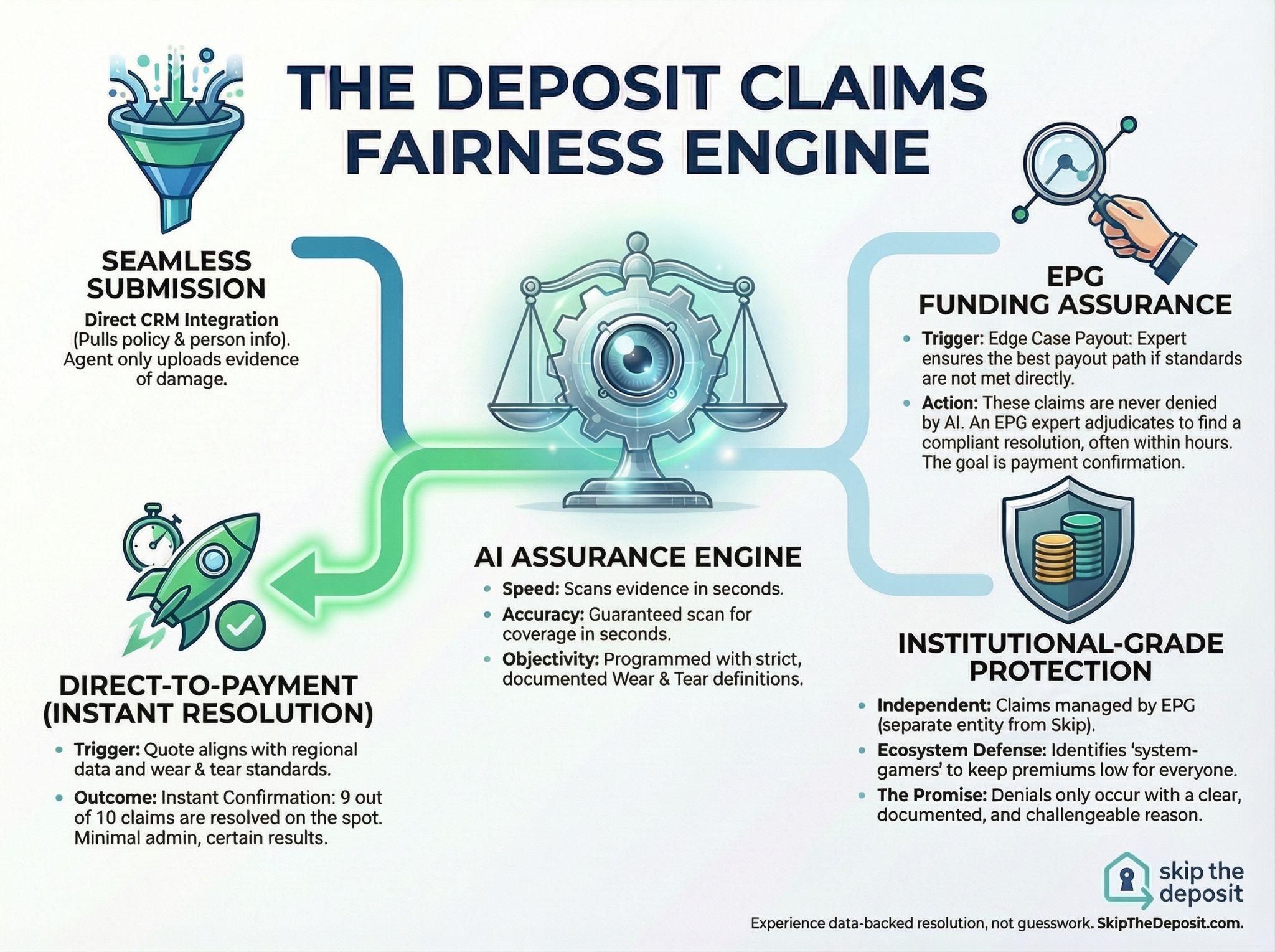
Skip the Deposit partners with EPG as the independent claims management entity. This distinction is worth dwelling on, because it is one of the most important structural decisions behind the product.
EPG and Skip the Deposit are entirely separate organisations. Skip the Deposit is the platform through which tenants and agents access deposit-free renting. EPG is the institutional partner that handles and adjudicates claims independently.
Crucially, EPG forms part of a wider group that includes [rb01], a well-established and highly-regarded UK insurance broker. This structure ensures that claims are handled within a deep, experienced insurance ecosystem, entirely separate from the platform selling the product. There is no conflict of interest — the company receiving the premium is not the company deciding whether to pay out. That structural independence is not a marketing point; it is the foundation of a trustworthy claims process that provides a “promise to pay” backed by institutional weight.
The EPG Philosophy
Claims are never denied without a clear, documented, and challengeable reason. The system is designed to pay claims that are properly evidenced — not to find reasons to avoid doing so.
The partnership is publicly visible on the Skip the Deposit platform. This transparency is intentional — it directly addresses the concern that a deposit alternative provider might sell a policy and then find reasons not to pay. Having a named, independent institutional partner visible to all parties removes that concern from the equation.
The AI Audit: Consistency Where There Was Subjectivity
The artificial intelligence component of the Fairness Engine is not a gimmick.
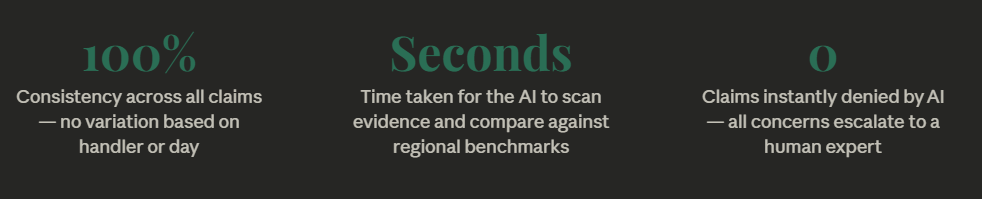
It solves a specific and well-defined problem: the fact that claim outcomes have historically varied depending on who happened to be handling them on a given day.
The AI is programmed with strict, documented definitions of general wear and tear. These definitions are not vague guidelines — they are precise standards against which submitted evidence and quotes are measured. When a claim arrives, the AI scans the supporting evidence in seconds, compares quotes against regional averages, and applies those documented wear and tear standards consistently across every single claim.
That last point is particularly significant. The AI does not deny claims. If it identifies a concern — for example, a quote that is substantially higher than the regional average for equivalent work — it flags the claim and escalates it automatically to a human expert inside EPG for review. The decision is never left to an algorithm alone. What the AI provides is objectivity and speed; what the human provides is judgement.
This model also protects the integrity of the system over time. The automated review process is designed to identify patterns — repeat attempts to submit inflated quotes, or multiple claims against the same property or person — and escalate these for closer scrutiny. Agents who partner with Skip the Deposit benefit from a system that actively defends against manipulation, which in turn keeps the product viable and premiums stable for everyone.
How a Claim Actually Works: From Submission to Resolution
One of the most persistent friction points in any claims process is administration. Agents spend hours gathering policy details, cross-referencing tenant information, and populating forms before the substantive claim work even begins. The Fairness Engine removes most of that burden by design.
The claims portal — built and owned by Monopoly Technologies — integrates directly with the letting agent’s existing system. When a claim is submitted, the portal pulls policy and person information automatically from the front end. The only thing the agent or landlord needs to provide is the evidence of damage itself.
The process then runs as follows:
- Submission: Evidence of damage is uploaded. Policy and tenant information is pulled automatically from the CRM. No manual data entry required from the agent.
- AI Instant Audit: The AI scans the evidence, benchmarks quotes against regional data, and applies documented wear and tear standards. This takes seconds.
- Fast Track (Automated Approval): If the quote aligns with regional data and the damage clearly exceeds fair wear and tear, the claim is approved automatically. Rapid payout, minimal back-and-forth.
- Human-in-the-Loop (Expert Review): If the AI detects an anomaly — such as a £500 quote for a job typically costing £50 — the claim escalates to an EPG expert for manual adjudication. The agent is never left without a resolution.
- Outcome with a Documented Reason: Every outcome, whether approved or declined, comes with a clear and challengeable explanation. No black-box decisions.
When Claims Are Declined: The Transparency Principle
Building genuine confidence in a claims process requires being honest about when and why claims are not paid. There are two primary reasons a claim may be declined, and neither of them is arbitrary.
- Insufficient evidence. A claim without adequate photographic documentation, checkout reports, or supporting materials cannot be validated. The system requires proof — not because it is looking for reasons to decline, but because a fair process requires both sides of the argument to be documented.
- Inflated quotes. Where a submitted quote is significantly above the regional average for equivalent work, it will be escalated for human review. If it cannot be justified, it will not be approved in full. This protects the system from being exploited and keeps premiums sustainable for all policyholders.
The critical point is this: any denial comes with a documented reason that can be challenged. This is not small print — it is a core operating principle for EPG. Agents and landlords who disagree with an outcome have a clear basis on which to appeal.
What This Means for Letting Agents
The practical impact of the Fairness Engine on a letting agent’s day-to-day work is significant. Rather than positioning yourself as the arbiter of a landlord-tenant dispute, you can instead point to a structured, independent, and documented process.
By moving to this model, agents gain three critical advantages:
- Reclaimed Time: Fewer end-of-tenancy disputes mean your property managers aren’t losing hours to “back-and-forth” emails.
- Reduced Conflict: Dramatically reduced exposure to the emotional friction of landlord/tenant stand-offs.
- Professional Distance: You gain a structured process you can point to, rather than a decision you have to defend personally.
When a landlord questions a claim outcome, your answer is no longer an opinion. It is: the claim was assessed against regional benchmarks by an AI system programmed with documented wear and tear standards, reviewed by an independent institutional partner, and the outcome came with a challengeable documented reason. That is a fundamentally stronger position
than anything an agent can offer by themselves. It shifts the burden away from the agency and onto a robust, external standard.
The Bigger Picture: Protecting the Ecosystem
One of the less-discussed advantages of an AI-driven, institutionally-backed claims process is what it does for the long-term viability of deposit-free renting. A system that can identify and flag patterns of misuse — whether that is inflated contractor quotes or serial claims against specific properties — protects the integrity of the product for everyone who uses it legitimately.
Agents who offer deposit-free options have a direct interest in ensuring the underlying product remains commercially sustainable. A claims process that is exploitable will eventually lead to increased premiums or withdrawn cover.
The Fairness Engine’s approach to anomaly detection and escalation is as much a benefit to agents and landlords as it is a safeguard for the insurer.
The goal is a rental market where the end-of-tenancy process is experienced as fair by all parties — not because everyone always gets exactly what they want, but because the process by which outcomes are reached is transparent, consistent, and documented.
Partner with Skip the Deposit
See how much time you could have saved on your last three disputes. Join letting agencies across the UK who are already offering tenants a smarter, fairer alternative to traditional deposits — backed by independent institutional protection and objective AI standards.