

The Renters’ Rights Act and Deposit Alternatives: What Changes and What Doesn’t
How periodic tenancies impact churn and why Skip the Deposit reduces risk.
For the UK private rented sector (PRS), the transition from the Renters’ Reform Bill to the Renters’ Rights Act represents more than just a name change; it marks a fundamental shift in the operational DNA of letting agencies and portfolios.
While much of the media focus has remained on the abolition of Section 21 ‘no-fault’ evictions, savvy landlords and agents are looking deeper at the mechanical changes, specifically the move to a purely periodic tenancy system. This structural shift has significant implications for how deposits are managed, how risk is mitigated, and how “tenancy churn” will impact your bottom line.
The Death of the Fixed Term: Understanding Tenancy Churn
Under the Renters’ Rights Act, all tenancies will move to a periodic structure from day one. The concept of a “fixed term” the traditional 6 or 12-month assurance of occupancy, is effectively being retired. After an initial 12-month protected period, during which landlords have greater security of tenure, tenants will be able to give two months’ notice at any point. This initial 12-month period actually aligns neatly with Skip the Deposit’s 12-month policy structure, providing landlords with a degree of continuity at the outset of every tenancy. For agents and landlords, the broader shift still introduces a key variable: increased tenancy churn. When tenants have the flexibility to move more frequently without waiting for a fixed-term expiry, the frequency of “end-of-tenancy risk events” naturally increases. Every time a tenant moves out, the administrative and financial machinery of deposit returns, damage disputes, and dilapidations kicks into gear.
New Rights, New Risks: Pets, Rent Reviews, and Dispute Resolution
Beyond the structural change to tenancy terms, the Renters’ Rights Act introduces several other provisions that landlords and agents need to factor into their risk planning. Tenants now have the right to keep pets. Requests cannot be unreasonably refused, which means pet damage is no longer an edge case, it’s a mainstream consideration. Skip the Deposit includes cover for pet damage (within reason), making it a natural fit for a market where pet-owning tenants are a growing and protected cohort. Rent increases under Section 13 are now limited to once per year, and landlords must provide supporting evidence such as demonstrable shifts in the local market to justify any increase. This introduces a more structured, evidence-based approach to rent reviews, reducing the risk of arbitrary increases but also placing an administrative obligation on landlords to document their rationale. All landlords must join the new Landlord Ombudsman, which will serve as the primary route for formal dispute resolution. While this offers tenants a recognised channel for grievances, the ombudsman process is likely to be slow-moving by nature, formal, bureaucratic, and backlogged. For landlords and agents dealing with end-of-tenancy claims, waiting months for an ombudsman ruling is operationally untenable. Skip the Deposit
resolves claims between 24 hours and 7 days, offering a faster, cleaner alternative that sidesteps the ombudsman process for deposit-related disputes entirely.
What Doesn’t Change: The Burden of Evidence
Despite the legislative overhaul, the fundamental requirement for successful claims remains identical. Whether you are using a traditional custodial deposit or an alternative, the move-in and move-out inventory remains the “gold standard” of evidence. The Renters’ Rights Act will likely see a push toward even greater transparency. Landlords will still need to prove:
- The condition of the property at the start.
- The condition at the end (allowing for fair wear and tear).
- The specific cost of remediation. In a world of periodic tenancies, the “admin fatigue” of managing these transitions more frequently becomes a genuine operational threat to letting agents.
The Friction of Traditional Deposit Schemes
Traditional cash deposits (capped at five weeks’ rent) are becoming increasingly “sticky” in a fast-moving market. As the cost of living remains high, tenants often struggle to produce a new five-week deposit before their previous one has been released. This creates a bottleneck, extending void periods for landlords. Furthermore, traditional schemes require re-registration or “statutory declarations” if certain parameters change. In a fluid, periodic environment, the administrative overhead of keeping deposit registrations compliant across a high-churn portfolio can lead to costly errors.
Why Skip the Deposit is the Operational Answer
As the PRS evolves, the tools we use must evolve from being static “vaults” to active “protection layers.” This is where Skip the Deposit departs from both traditional cash deposits and first-generation deposit replacement schemes. Most deposit alternatives on the market operate on a “reimbursement” model. If a tenant causes damage, the provider pays the landlord but then pursues the tenant for the debt. This “chasing” dynamic often leads to protracted disputes, as tenants are incentivised to fight every penny of a claim to avoid personal debt recovery. Skip the Deposit offers a cleaner, insurance-backed model specifically designed for the Renters’ Rights era:
- Property-Linked, Continuously Active: Unlike schemes that require re-registration for every new “term,” Skip the Deposit provides cover that is linked to the property. This handles
the move to periodic tenancies seamlessly, ensuring protection doesn’t lapse as tenants move in and out.
- The Insurer Absorbs the Risk: This is the critical differentiator. Our insurer carries 100% of the deposit risk. Unlike other schemes, the tenant is not chased for the money after a claim is settled.
- Pet Damage Included: With tenants now having a legal right to keep pets, this is no longer an optional extra it’s essential protection. Skip the Deposit covers pet damage as standard (within reason), so landlords aren’t left exposed by the new legislation.
- Reduced Dispute Friction: Because the tenant isn’t facing post-tenancy debt recovery, the incentive to baselessly dispute legitimate claims is significantly reduced. This leads to faster resolutions.
- AI-Assisted Claims Triage: Speed is the enemy of void periods. By using AI-assisted triage and a dedicated UK claims team, Skip the Deposit typically resolves claims between 24 hours and 7 days.Far quicker than any ombudsman process.
Future-Proofing Your Portfolio
For letting agents, Skip the Deposit isn’t just a way to attract tenants by lowering move-in costs; it is a tool to reduce the administrative burden of the Renters’ Rights Act. By removing the “middleman” role that agents often play in deposit disputes and replacing it with a centrally handled, evidence-driven insurance model, agents can focus on growth rather than grit. As we move into this new legislative landscape, the goal is simple: minimise the friction of the move-out process. By adopting a property-linked, insurance-backed solution like Skip the Deposit, landlords and agents can turn the challenge of periodic tenancies into a streamlined, risk-mitigated operational advantage.
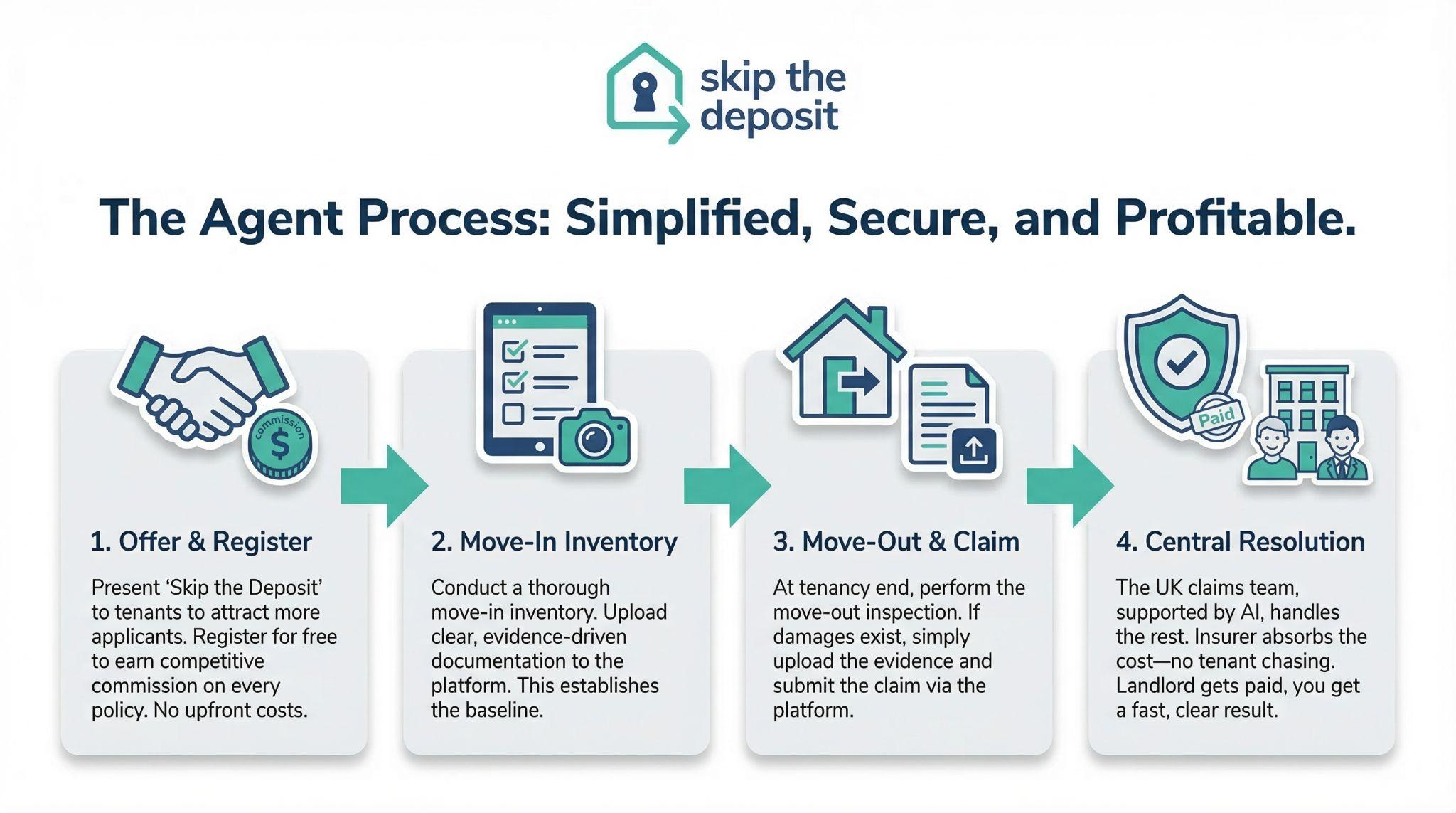
If you’re an agent and want to learn more about the process, please see our explainer visual below.
For letting agents
Ready for lower-friction move-outs?
Book a short walkthrough to see how property-linked, insurance-backed cover can reduce deposit admin, protect against new Renters’ Rights risks, and keep claims moving in days — not months.